
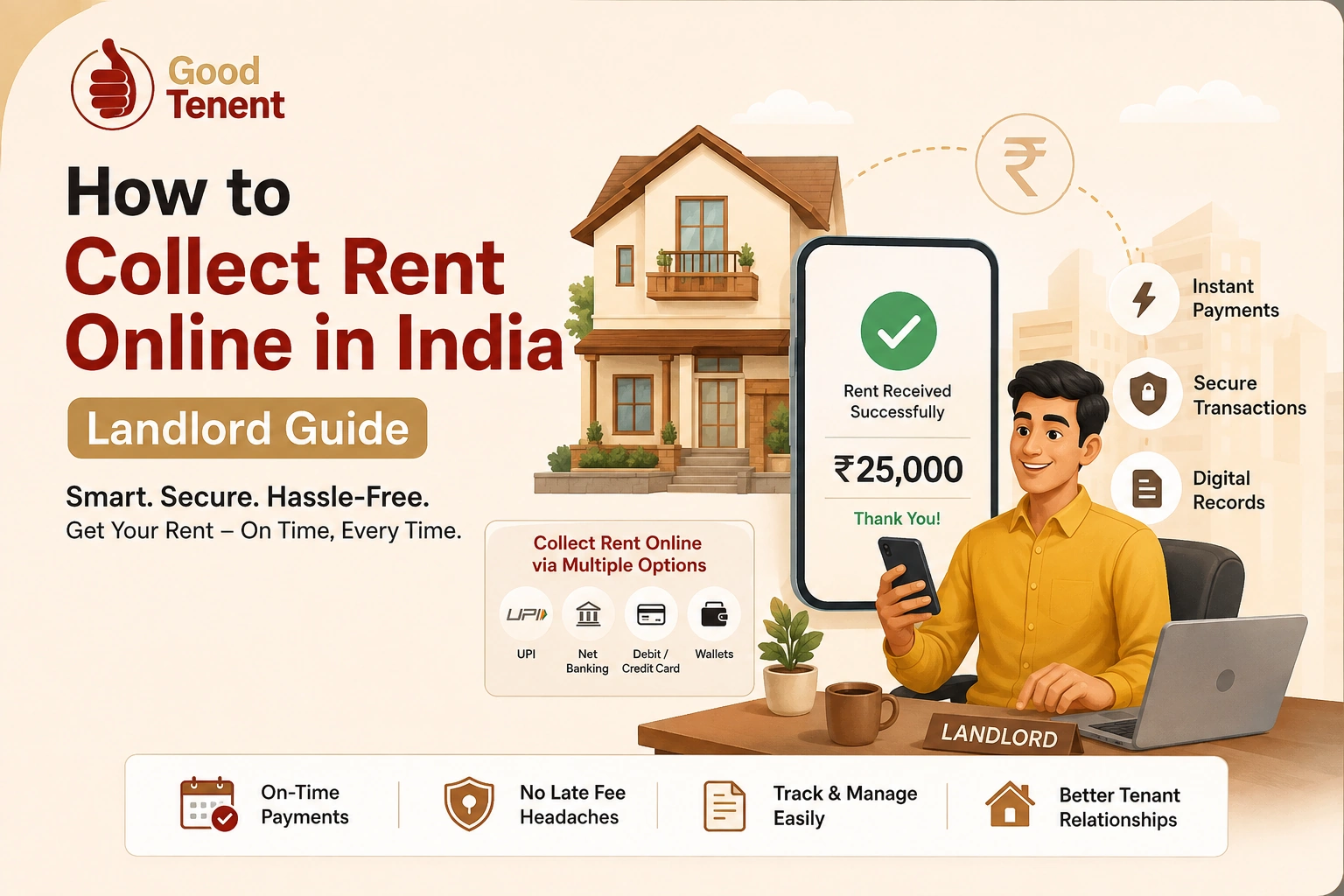
How to Collect Rent Online in India: A Landlord's Guide to Digital Rent Payments
If you're still tracking rent through bank passbook entries and WhatsApp follow-ups, you're leaving money — and time — on the table. Digital rent collection isn't just more convenient; it creates the paper trail landlords need for tax filing and the payment discipline that reduces late rent.
The fastest way to collect rent online in India is via UPI, which is free and instant but capped at ₹1 lakh per transaction for most banks. For automatic reminders, digital receipts, and a payment record you can hand to your CA at tax time, a dedicated rent collection app — like the Wallet feature inside GoodTenent — does everything UPI can't: recurring reminders, receipt generation, and a single dashboard if you manage more than one property.
What "Online Rent Collection" Actually Means in India
Online rent collection covers any method where rent moves from tenant to landlord without cash or a physical cheque changing hands. In India that spans four real options:
- UPI (Google Pay, PhonePe, Paytm, BHIM, or any bank's UPI handle)
- Bank transfer (NEFT, IMPS, RTGS)
- Credit card, usually routed through a third-party app since landlords can't accept card payments directly
- A dedicated rent collection app or platform, which usually uses UPI or cards under the hood but adds reminders, receipts, and record-keeping on top
The right choice depends less on "which is most modern" and more on rent amount, whether you manage one property or several, and whether you need the payment trail for tax purposes.
Comparing Your Options: UPI vs Bank Transfer vs Credit Card vs Rent App
|
Method |
Cost |
Speed |
Per-transaction limit |
Automatic receipt |
Best for |
|---|---|---|---|---|---|
|
UPI (direct) |
Free |
Instant |
₹1 lakh/day (most banks) |
No — manual screenshot only |
Single property, rent under ₹1L |
|
NEFT/IMPS/RTGS |
Free–₹25 (bank dependent) |
Instant (IMPS/RTGS) to few hours (NEFT) |
Bank-set, usually higher than UPI |
No |
High-value rent, NRI landlords |
|
Credit card (via third-party app) |
1–3% convenience fee, passed to tenant |
Instant to 24 hrs |
Card limit |
Sometimes |
Tenants wanting card rewards/float |
|
Rent collection app (e.g. GoodTenent Wallet) |
Free–low fee, varies by plan |
Instant (UPI-backed) |
Same as UPI/bank rails |
Yes — auto-generated |
Multi-property landlords, PG/hostel owners, anyone who wants a compliance-ready record |
A rent collection app isn't a separate payment rail — it's a layer of automation, tracking, and documentation sitting on top of UPI or card rails. That's the real distinction to make for tenants and landlords comparing options.
Step-by-Step: Setting Up Online Rent Collection
- Fix the payment date and mode in the rental agreement. Ambiguity here is the single biggest cause of late rent disputes. If you haven't formalized this yet, get the digital rental agreement in place first — it should explicitly state due date, accepted mode, and late fee terms.
- Verify the tenant before handing over recurring payment access. A tenant verification check upfront reduces the odds of chasing a defaulting tenant later.
- Choose your collection method based on the comparison table above — UPI for simplicity, a rent app if you manage multiple units or want automated records.
- Set up recurring reminders. Manual reminders get skipped; automated ones (WhatsApp or SMS, sent 2–3 days before due date) measurably reduce delays.
- Generate a receipt every month — without exception. This matters more than most landlords realize (see the HRA section below).
- Reconcile monthly. Whether in a spreadsheet or inside an app dashboard, keep a running log so nothing falls through the cracks across multiple tenants or properties.
UPI Rent Payments: What the ₹1 Lakh Limit Means for You
UPI is free and instant, which makes it the default choice for most landlords. But the standard daily cap is ₹1 lakh per user across most banks, and this catches out landlords in metro cities where monthly rent for a 2BHK or independent house can easily cross that threshold.
If your rent exceeds ₹1 lakh:
- The tenant can split the payment across two UPI transactions on different days (impractical if rent is due in full on the 1st)
- Switch to IMPS or RTGS for that specific payment, which typically carries a higher or no daily cap depending on the bank
- Use NEFT, which has no NPCI-mandated cap but settles in batches rather than instantly
There's no fixed monthly or annual UPI limit set by NPCI — the constraint is purely the daily cap, so high-rent households in Mumbai, Bengaluru, or Delhi NCR need a fallback method built into their process from day one rather than discovering the cap on move-in day.
Check the Tenant Verification in High Rent Cities
| Delhi | Bengaluru | Mumbai | Kolkata | Gurgaon |
Should Tenants Pay Rent by Credit Card?
Landlords generally can't accept credit card payments directly — there's no merchant infrastructure for peer-to-peer rent. Tenants route card rent payments through third-party apps (CRED, RedGiraffe, and similar), which charge a convenience fee — typically 1–3% of the rent amount — that the tenant absorbs in exchange for card rewards, cashback, or simply extending their payment cycle by using card credit instead of cash-in-hand.
Two things worth flagging to tenants who ask about this:
- Some card issuers treat rent payments through these apps as a cash-equivalent transaction on certain card types, which can trigger cash-advance fees separate from the platform's convenience fee. Worth checking with the card issuer first.
- The convenience fee isn't recoverable — it's a cost of using the card, not a landlord charge, so it shouldn't be confused with rent itself in any record-keeping.
TDS on Rent: What Landlords and Tenants Need to Track
This is the part most "how to collect rent online" content skips entirely — and it directly affects how you should be recording digital rent payments.
Section 194-IB applies when an individual or HUF tenant (not subject to tax audit) pays rent above ₹50,000 per month to a resident landlord.
|
Detail |
Rule |
|---|---|
|
Who deducts |
The tenant |
|
Threshold |
Rent exceeding ₹50,000/month |
|
TDS rate |
2% (reduced from 5%, effective October 1, 2024) |
|
Rate if landlord has no PAN |
20% |
|
When deducted |
Once a year — at the earlier of the last month of the financial year or the last month of tenancy |
|
Form to deposit TDS |
Form 26QC (no TAN required) |
|
Certificate issued to landlord |
Form 16C, within 15 days of filing Form 26QC |
|
Filing deadline |
Within 30 days from the end of the month TDS was deducted |
If your monthly rent is ₹50,000 or below, none of this applies — TDS simply isn't triggered. If it's above that threshold, the digital payment trail from UPI or a rent collection app becomes the exact documentation both parties need to reconcile rent paid against TDS deducted at year-end. This is precisely where an app-based record (rather than scattered UPI screenshots) saves both sides from a scramble every March.
Read More: How to Pay TDS on Rent Above 50000
Why Digital Rent Receipts Matter Beyond Convenience
Salaried tenants claiming HRA exemption need rent receipts as supporting documentation — and receipts for rent above ₹1 lakh/year (roughly ₹8,333/month) require the landlord's PAN on the receipt itself. A rent collection app that auto-generates a receipt on every payment removes the year-end scramble to reconstruct twelve months of proof from bank statements, and gives the landlord an identical record to reconcile against TDS if applicable.
Choosing the Right Rent Collection App: A Checklist
Not every "rent payment" app is built for landlords running this as an actual operation. Before picking one, check for:
- Automated reminders — WhatsApp or SMS, not just in-app notifications tenants can ignore
- Instant digital receipts — generated automatically, not requested manually each month
- Multi-property dashboard — if you manage more than one unit, a single consolidated view matters more than any single feature
- Partial payment handling — does it track partial payments cleanly, or does it just show a binary paid/unpaid status?
- Payment history export — for TDS reconciliation or simply handing records to your CA
- No forced tenant sign-up friction — the easier it is for the tenant, the fewer excuses for delay
Common Mistakes Landlords Make Moving to Digital Rent Collection
- Switching payment mode without updating the rental agreement. If the agreement still says "cash" or is silent on mode, disputes get harder to resolve. Fix this at the agreement stage.
- Not generating receipts consistently. A receipt for 10 months out of 12 isn't a record — it's a gap that surfaces exactly when you need it (tax filing, deposit disputes).
- Assuming UPI has no limit. It does, and metro-city rents cross it more often than landlords expect.
- Ignoring TDS entirely. If rent crosses ₹50,000/month, both parties have compliance obligations — payment method doesn't remove them.
- No fallback for repeat delays. If a tenant is chronically late despite reminders, that's a pattern worth checking against a defaulter database before renewal, not after another missed month.
FAQs
Is UPI rent payment safe?
Yes. UPI transactions are encrypted and protected by two-factor authentication. The only real risk is sharing your UPI PIN or scanning an unfamiliar QR code — never required for receiving a standard rent payment.
What is the best way to collect rent online in India?
For a single property with rent under ₹1 lakh, direct UPI is simplest and free. For multiple properties, PG/hostel operations, or landlords who want automatic reminders and receipts, a dedicated rent collection app is more reliable long-term.
Do I have to pay TDS if I pay rent via UPI or a rent app?
The payment method doesn't change TDS obligations. If you're an individual or HUF tenant paying more than ₹50,000/month, Section 194-IB applies regardless of whether you pay by UPI, bank transfer, or card.
Can I collect rent above ₹1 lakh through UPI?
Not in a single transaction for most banks, since the standard daily UPI cap is ₹1 lakh. Split it across two days, or use IMPS/NEFT/RTGS for the full amount in one transaction.
Is a rent receipt required if I pay rent digitally?
Yes, especially if the tenant is claiming HRA exemption. A digital payment isn't automatically treated as a rent receipt for tax purposes — a proper receipt (with landlord PAN, if annual rent exceeds ₹1 lakh) should still be issued monthly.
Are rent collection apps safe to link with a bank account?
Reputable apps route payments through licensed payment aggregators (RBI-regulated) and don't store card or bank credentials directly. Check for this before linking any account.