How to Resolve a Rental Dispute in India: Legal Options for Landlords and Tenants
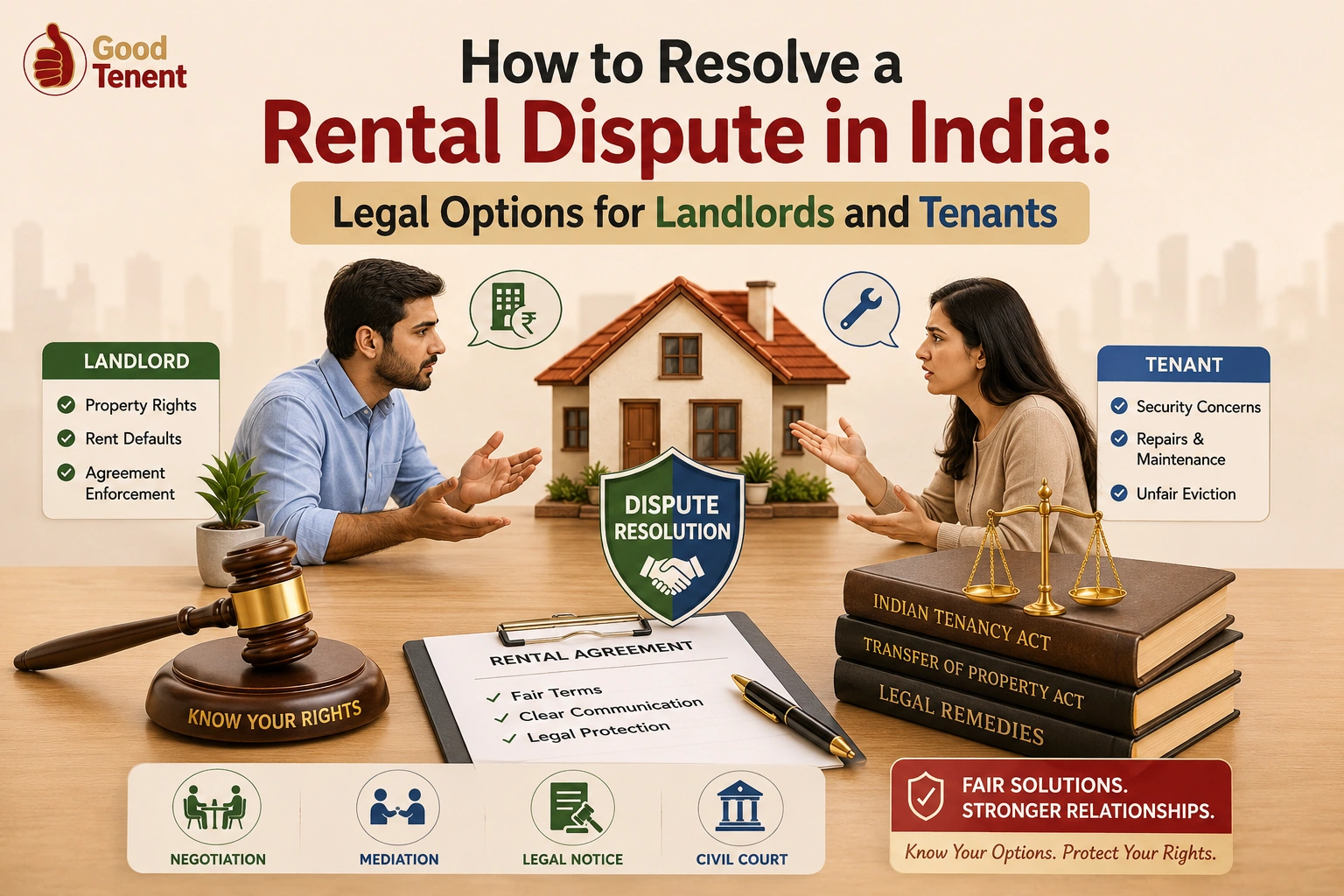
Rental disputes in India can be resolved through direct negotiation, mediation (often via the RWA), the Rent Authority/Rent Court/Rent Tribunal system under state tenancy laws, civil court, or arbitration — but arbitration is only legally available for tenancies that fall outside your state's Rent Control Act coverage. The right route depends on what kind of dispute you have and which law governs your tenancy.
Rent disputes are one of the most common friction points between landlords and tenants in India — late payments, security deposit deductions, maintenance disagreements, and disputed evictions all show up regularly. What's less well understood is that India doesn't have a single dispute-resolution path for these cases. The right option depends on your state, the type of dispute, and whether your tenancy is governed by an older Rent Control Act or the newer Model Tenancy Act framework.
This guide walks through every legal option available, in the order most disputes should actually try them — starting with the fastest and cheapest, moving to the most formal.
Common Types of Rental Disputes
- Non-payment or late payment of rent
- Security deposit withheld or disputed at move-out
- Illegal or forceful eviction
- Property damage or maintenance disagreements
- Unauthorised subletting
- Rent hike disputes
- Breach of agreement terms (notice period, usage clause, etc.)
- Harassment or access disputes (landlord entering without notice, tenant denying access for repairs)
Related: Security Deposit in Rent Agreement Laws and Refund Rules
Step 1: Review the Agreement and Send a Written Notice
Before escalating anywhere, most disputes should start with a written notice — not a phone call or a verbal warning. A written notice referencing the specific clause in dispute (rent due date, deposit terms, notice period) does two things: it gives the other party a documented chance to respond, and it becomes evidence if the matter escalates later.
If you don't have a written rental agreement to point to, this is the point where disputes get harder to resolve — verbal tenancies leave both sides with little to stand on.
Related: What Documents Are Required for a Rent Agreement
Step 2: Mediation — Through the RWA or a Neutral Third Party
In disputes that do not have a criminal element mediation is often the quickest and least adversarial next step. The Resident Welfare Association (RWA) or housing society committee or an outside mediator may assist in negotiating an agreement that is mutually beneficial such as settling on a deposit deduction that is only a portion instead of a full-blown dispute about damages.
Mediation isn't binding unless both parties sign a settlement agreement, but it resolves a large share of rental disputes without either side needing to file anywhere formally.
Step 3: Rent Authority, Rent Court, or Rent Tribunal (Where Applicable)
States that have adopted the Model Tenancy Act framework — including Uttar Pradesh, Assam, Tamil Nadu, and Andhra Pradesh, among others — route tenancy disputes through a dedicated three-tier system:
- Rent Authority — the first point of contact, primarily for registration and initial complaints
- Rent Court — handles disputes over rent, eviction, deposits, and agreement terms
- Rent Tribunal — hears appeals against Rent Court decisions
This system is designed to be faster than civil court, with several states targeting resolution timelines of 60–90 days for straightforward cases. If your state hasn't adopted this framework, your tenancy will typically fall under an older state-specific Rent Control Act instead, with a different (and often slower) process.
Related: Understanding the Model Tenancy Act
Step 4: Civil Court
Civil courts remain the default route for disputes that don't fall under a Rent Court/Tribunal system, and for matters that are simply too serious or complex for mediation — large-scale property damage, disputed ownership claims, or a tenant refusing to vacate after a valid eviction order. Civil litigation in India is thorough but slow, often taking many months to reach resolution, and involves formal filing, evidence, and legal representation.
Courts are also the only route available when criminal conduct is involved — forged documents, threats, or forcible entry — since these fall outside what mediation, Rent Courts, or arbitration can address.
Step 5: Arbitration — Where It Actually Applies
Arbitration is often positioned as a faster, private alternative to court, and where it's legally available, it can be. However, it's essential to be precise about what it means: Indian courts have consistently determined that disputes over tenancy subject to the law of the state Rent Control Act cannot be arbitrated regardless of whether the rental agreement has an arbitration clause. These disputes fall under the exclusive jurisdiction of the Rent Controller or Rent Court as a matter of public policy.
Arbitration clauses in a rental agreement are generally enforceable when:
- The tenancy is exempt from your state's Rent Control Act — many state Acts exclude properties above a certain rent threshold
- The property falls under a Model Tenancy Act state's framework that permits it, or a commercial lease not covered by rent control
- Both parties have explicitly accepted arbitration clause in a registered written agreement
If arbitration is allowed in the majority of cases, it resolves disputes more quickly and private than courts, and with a binding and enforceable award pursuant to the Arbitration and Conciliation Act, 1996. Where it doesn't apply, attempting arbitration first just adds a delay before the matter has to go to the Rent Court or civil court anyway — so it's worth confirming eligibility before choosing this route.
Step 6: Police Complaint (For Criminal Matters Only)
If a dispute is involving physical threats or forcible entry, damage that could be considered vandalism, or harassment an investigation by the police is an independent and legitimate option, separate from any civil dispute regarding rent or deposits. The police intervention does not resolve the issue of tenancy however it does address the criminal aspect while the civil dispute is dealt with in the appropriate forum.
Which Route Fits Your Dispute?
|
Dispute Type |
Best First Step |
Escalation Route |
|---|---|---|
|
Late or unpaid rent |
Written notice |
Rent Court / Civil Court |
|
Security deposit withheld |
Mediation |
Rent Court / Consumer forum (limited applicability) |
|
Illegal eviction |
Written notice |
Civil Court (urgent relief) |
|
Property damage dispute |
Mediation |
Rent Court / Arbitration (if eligible) |
|
Subletting or lease breach |
Written notice |
Rent Court / Arbitration (if eligible) |
|
Harassment or forced entry |
Police complaint |
Civil Court (criminal + civil) |
|
High-value commercial lease dispute |
Written notice |
Arbitration (commonly eligible) |
Documents You'll Need, Whichever Route You Take
- The signed rental agreement
- Rent payment records or bank statements
- Written notices or correspondence already exchanged
- Photographs or inspection reports, for damage or condition disputes
- ID proof for both parties
Related: Rental Property Inspection Checklist
How GoodTenent Helps
Not every dispute needs the same kind of help, which is why GoodTenent splits this into two services:
- GoodTenent Legal Cell — start here if you're not yet sure which route applies to your situation. The Legal Cell reviews your agreement and dispute, and advises on whether mediation, Rent Court, civil court, or arbitration is the right next step.
- GoodTenent Arbitration — use this once you know your dispute is eligible for arbitration and you want a binding, private resolution without going to court.
If you haven't yet signed a rental agreement, building an arbitration clause into it from the start — where your tenancy qualifies — can save time if a dispute comes up later. Create a digital rental agreement with GoodTenent.
FAQs About Resolving Rental Disputes in India
Q1. Can rental disputes be resolved without going to court?
Yes — mediation, Rent Authority/Rent Court proceedings (where your state has adopted this system), and arbitration (where eligible) can all resolve disputes without a civil court case.
Q2. Are all rental disputes eligible for arbitration?
No. Disputes covered by a state Rent Control Act generally cannot be arbitrated, even with an arbitration clause in the agreement — courts have held these fall under the exclusive jurisdiction of Rent Courts as a matter of public policy. Arbitration is more commonly available for tenancies exempt from rent control or covered under a Model Tenancy Act state framework.
Q3. What is a Rent Court, and does every state have one?
A Rent Court is a quasi-judicial body created under the Model Tenancy Act framework to hear tenancy disputes faster than civil court. Not every state has adopted this system — several states, including Uttar Pradesh, Assam, Tamil Nadu, and Andhra Pradesh, have; others still operate under older Rent Control Acts.
Q4. Can a tenant take a landlord to consumer court?
Rarely, and only in limited circumstances — consumer forums generally apply where a service is availed for consideration from a service provider, which doesn't typically describe an individual landlord-tenant relationship. Most disputes are better routed through mediation, Rent Court, or civil court.
Q5. How long does it take to resolve a rental dispute in India?
It varies widely by route: mediation can resolve in days to weeks, Rent Court proceedings often target 60–90 days in adopting states, and civil court cases can take many months depending on backlog.
Q6. What should I do first if I have a rental dispute?
Send a written notice referencing the specific clause in dispute, then attempt mediation before escalating to a Rent Court, civil court, or arbitration.
Final Thoughts
There's no single "right" way to resolve a rental dispute in India — the right path depends on what the dispute is about, whether your state has adopted the Model Tenancy Act framework, and whether your tenancy is even eligible for arbitration. Starting with a written notice and mediation resolves most disputes without ever needing a formal filing. When it doesn't, knowing which forum actually has jurisdiction over your case — rather than assuming arbitration or court is available — saves time before you file anywhere.
Get expert guidance on your situation from the GoodTenent Legal Cell