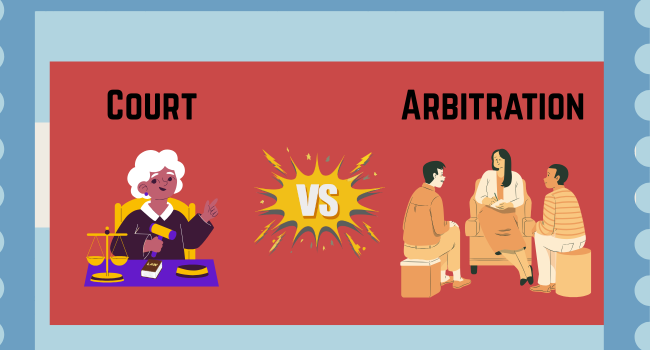
Court vs Arbitration: Fastest Way to Resolve Rental Disputes in 2025
Court vs. Arbitration: When a rental dispute arises over rental payments, property damage, or a breach of the tenancy agreement's terms, the question that both landlords and tenants will ask is: Which is the quickest and most efficient way to resolve the issue? Conventionally, individuals would turn to the court system, but over the last few years, arbitration has been adopted as a more desirable way of resolving rental disputes. Both solutions are good, but in most cases, one solution emerges as the fastest, most convenient, and cost-effective.
This comprehensive comparative discussion places court vs arbitration in the quest to understand who is the ultimate winner when it comes to resolving rental disputes in a short time. As the number of conflicts in the rental market increases, particularly in the rapidly growing cities and semi-urban areas, knowing the correct process can save time, money and tension between the landlords and their tenants.
The Growing Need for Fast Rental Conflict Resolution
As the number of tenants that move between cities rises, the number of digital listing rental properties rises, and the rate of rental turnover rises, the conflicts are increasing. The problems of late payment of rent, unlawful subletting, misuse of property, failure to pay the deposit and breach of the rental agreements tend to spiral out of control. Numerous landlords are faced with delayed procedures in the legal courts, and on the other hand, tenants fear unjust results.
This is where formal dispute-solving processes such as arbitration, mediation and online rental dispute-solving are becoming popular. They offer quicker results relative to the traditional courts and lessen the responsibility of protracted courts of law.
Court Litigation: An Older Time-Consuming Process.
The official means of dispute settlement in India has been the courts. They provide a system of legal procedures, binding decisions and redress. Nevertheless, litigation is also associated with procrastination.
Why Courts Are Slower in Rental Conflicts?
Backlogged Cases: Civil courts are known to receive a number of thousands of cases at once. The rental litigations are put on hold with other civil cases, and thus make people wait in long lines.
Multiple Hearings: The hearings can be separated by weeks. The process of renting in most cities requires 824 months before a decision is made.
High Legal Costs: Litigation is costly in terms of court fees, lawyer fees, documentation, and miscellaneous expenses.
Complex Procedures: Submission of petitions, evidence, cross-examinations, and documents entails expertise in the law, and thus, both parties find this process tedious.
Nevertheless, courts are still resorted to where the issue at hand demands the high deadlock of law or where arbitration does not suffice in the rent agreement. Courts can be given greater power in the case of harshness, such as eviction because of criminal behaviour, forged documents, and destruction of property.
Read More: Digital Badges, Online Reports & Arbitration Tools
Arbitration: The Solution to Rental Conflict Faster, Modern.
Arbitration is the way of settling a dispute in renting that is gaining preference, particularly when the speed and cost of a dispute are important. It is a legally accepted kind of Alternative Dispute Resolution (ADR) where an impartial arbitrator gets to choose the course of action.
Why Arbitration Is Significantly Faster?
Single Arbitrator, Fewer Hearings: An arbitration typically ends in 30-90 days, as compared to courts, since there are fewer and simpler hearings.
Flexible Scheduling: Parties are able to schedule dates depending on convenience. Online arbitration, which is currently popular in rental contracts, further hastens the process.
Cost-Effective: Arbitral charges are usually significantly lower compared to the continued court proceedings. It also removes lawyer fees that are repeated.
Private and Confidential: Arbitration hearings are confidential, unlike court, and this safeguards the reputation of both the landlord and the tenant.
Legally Binding Decision: The award of the arbitrator is binding in law according to the Arbitration and Conciliation Act, and therefore, the losing party has no option but to obey.
Also Read: When Landlord-Tenant Conflicts Cross the Line
Key Difference between Court vs Arbitration
|
Feature |
Court |
Arbitration |
|
Time Duration |
Months to Years |
Days to Week |
|
Privacy |
Public |
Confidental |
|
Cost |
High |
Low- Affordable |
|
Atmosphere |
Adversarial |
Solution-Oriented |
|
Flexibility |
Very Low |
High |
|
Outcome |
Legally Binding |
Legally Binding |
|
Suitabilty |
Serious Criminal or Civil Suits |
Rental Conflicts and Tenancy Disputes |
|
Relationship Impact |
Most relationships break up |
Relationships often preserved |
|
Remote Participation |
Rarely |
Fully available |
Arbitration offers a quicker way of resolving conflicts in most cases of rental conflicts. Arbitration is evidently a quicker mode of conflict resolution for most rental disputes. This pace is critical to the landlords who rely on punctual payments of rents and tenants who require fast closure to prevent financial pressure.
Why Arbitration Works Better for Modern Rental Agreements?
In the current world, it is more common to find that a larger number of landlords are putting an arbitration clause in the digital rental agreement. This provision indicates that any conflict that emerges out of the agreement is going to be addressed by arbitration rather than by going to court.
Advantages of including an arbitration clause in a rental agreement.
- Guarantees a quicker resolution in case of a dispute.
- Guarantees the landlord and the tenant protection against protracted cases.
- Reduces overall legal costs
- Promotes negotiation and openness.
- Facilitates a smooth online dispute resolution on rental.
- Enhances the professionalism and the legal power of rental contracts.
Online arbitration is also being prompted by the digital rental platforms and rental property management applications since it fosters trust and facilitates a systemic approach to dispute management.
Which Rental Conflicts should be resolved by arbitration?
Most issues that are related to rentals, like:
- Deposit disputes
- Rent non-payment
- Assessment of property damages.
- Maintenance disagreement
- Lease-clause violations
- Early termination disputes
- Misuse of property
- Subletting disputes
Such disputes do not need a lot of legal intervention and can be made up of evidence, agreement clauses, and documentation.
Where Court the Better Alternative?
Although arbitration is quicker, some circumstances demand a more powerful law enforcement. Courts are better when:
The tenant will not comply with a decision of arbitration.
It has criminal involvement, not such as forgery or fraud.
Police help is needed in an eviction.
The conflict does not come within the arbitration clause.
It is a government issue or a legal stay order of the property.
The legal authority of the courts is more comprehensive, particularly in extreme cases.
Read More: Corporate Lease Misuse Exposed
Final Judgment: Court vs Arbitration — Who Really Wins?
When the emphasis is made on speed, convenience, less expense and reduced stress, arbitration wins the battle. It solves the dispute in a rental three to six times quicker than judicial court disputes and puts the two out of protracted and complex litigation. Through the rise of digital contracts and online arbitration platforms, landlords and tenants are finally able to find a fast, reliable method of resolving their disagreements.
Due to the growth of rental markets in large and Tier-2 cities, fast rent dispute resolution becomes necessary to simplify the management of the property. Arbitration also conserves time, besides promoting better communication and fairness in landlord-tenant relations.
Conclusion
The true victor in the Court vs Arbitration debate is therefore clearly Arbitration as the fast solution to resolving all rental disputes. It provides an efficient, less expensive, and legally binding procedure that gives strength to both landlords and tenants. By incorporating an arbitration provision into the renting agreements and selecting the online dispute resolution systems, property owners will be able to stay out of protracted court proceedings and carry out their renting businesses efficiently.
Arbitration should be the main option in case you are a landlord or tenant and want to resolve and solve conflicts within the shortest time.
FAQs: Court vs Arbitration for Rental Conflict Resolution
1. Which is faster for resolving rental disputes — court or arbitration?
Ans. The process of arbitration is much faster as compared to court litigation. The average rentals resolved under arbitration require 30-90 days, and the court proceedings require 8-24 months because of the backlog and several hearings.
2. Is arbitration legally binding for landlord–tenant conflicts?
Ans. Yes. The award of arbitration is legally binding as stipulated in the Arbitration and Conciliation Act, in that the landlord and tenant are bound by the award. The award is also enforceable by the court in case one of the parties declines to comply.
3. Can rental disputes be resolved online through arbitration?
Ans. Absolutely. Online rental dispute resolution is currently implemented in many platforms, which means that landlords and tenants are able to provide documents, pieces of evidence, and statements online. This will save time and spare the in-person hearings.
4. When should a landlord choose court instead of arbitration?
Ans. It can be better when the court litigation is associated with criminal activity, forged documents, illegal possession, and in cases when police intervention is needed during eviction. Serious cases have greater enforcement capabilities by the courts.
5. Should an arbitration clause be included in the rental contracts?
Ans. It is strongly advisable to include an arbitration clause. It guarantees a more expedited resolution, less expenditure on litigation, and an easier process of dispute handling. In the absence of this provision, the case can simply be transferred to a civil court.
6. Is arbitration less expensive than court disputes on rentals?
Ans. Yes. Arbitration is also relatively cheap, and there are fewer hearings and reduced documentation/lawyers' expenses. Instead, court litigation may be very costly due to extended hearings and the costs of the procedure.