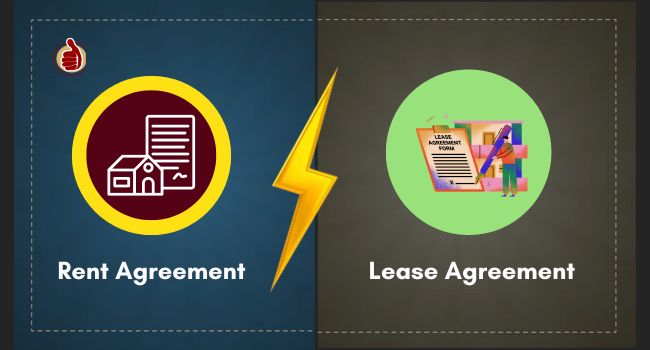
Lease vs Rent Agreement: Understanding the Difference Between Leasing and Rental agreement
Lease vs Rent Agreement: Lease and rent are two terms that you will come across in the real estate market, be it in residential or commercial property. They have different legal, financial and practical implications, although they are interchangeably used by people. To both landlords and tenants, it is very important to appreciate the difference between leasing and rental to avoid extra charges due to misinterpretation. This paper will examine the key differences, present the concept of rent agreement apps, outline the main characteristics of the leasing/renting models, and mention the main selling points and trends.
What Is a Rent Agreement?
A rent agreement (or tenancy agreement) is a contract between a property owner (landlord) and a tenant, where the tenant temporarily uses the landlord’s property in exchange for regular payments (rent). The term of rent contracts is not necessarily long-term, but is usually based on a month-to-month or shorter period. With the introduction of the new rent agreement rules in India, tenants and landlords will have to abide by new rules on registration, rent increase, security deposit, and digital documentation, which will make the process of renting more transparent and legally safe.
Rent Agreements are generally flexible; the following points are generally mentioned in the agreement for a smooth rental experience.
- The rate of rent is negotiable at the expiration of the term (or by prior notice).
- More flexible: both parties are allowed to enter into a termination at notice.
- The landlord usually has to undertake maintenance and some repairs (unless otherwise specified in the contract).
- In today’s modern world, digital rental agreements are the future, allowing you to create an agreement, e-sign it, and securely store it using digital technology.
What is a Lease Agreement?
A lease agreement is a contract with a longer period of time. The agreement gives the right to use a property with definite terms. Rent and the majority of contractual conditions are fixed in place during the lease period - the landlord cannot normally change them halfway through. Commercial properties are normally leased or purchased in case of stability. Registration, stamp duty, etc, are more formal in case of leases.
Core Features and Services in Leasing and Renting
In leasing or renting, several core features and services are required:
- Subscription Models: Landlords can provide different types of subscription systems, i.e. monthly, quarterly or annual leases to fit in different requirements of the tenants.
- User Roles: Landlords, tenants and property managers. The segregation of roles creates clarity in the smooth running and accountability of the operations.
- Badges and Ratings: It can be used to build trust and credibility by implementing a badge system for verified landlords or tenants.
- Unique Selling Propositions (USPs): Such distinctive aspects, as pet-friendly
policies or environmentally friendly options can appeal to a certain group of tenants.
Read More: How to Make Rental Agreements Legally Stronger with Digital Contracts
Lease vs Rent Agreement: Difference Between Leasing and Rental
The one and the biggest distinction between a lease and a rental agreement is the term of the contract:
| Features |
Lease Agreement |
Rent Agreement |
|
Time Duration |
Fixed terms, typically long-term (6-12 Months Longer). |
Short-term, typically a month-to-month (30 Days). |
| Rent Changes |
The rent amount is fixed for the entire term and can’t be changed by the landlord. |
Rent can be changed (raised or lowered) with proper notice (usually 30 days) at the end of any period. |
| Automatic Renewal | Does not automatically renew; requires a new agreement or moves to month-to-month after the term ends |
Automatically renews at the end of each period (e.g., month) unless proper notice is given |
| Breaking the Contract |
Difficult and usually incurs significant financial penalties (e.g., paying the remaining rent). |
Easier for either party to terminate the agreement with proper, usually 30-day, notice. |
| Legal Formalities |
More complex; often requires registration and stamp duty. |
Simpler; may only require notarization. |
| Maintenance |
Responsibilities vary; they may be shared or the tenant's duty |
Typically, the landlord handles major repairs. |
Processes Involved in Leasing vs Renting
1. Property Listing
Lease: The long-term commitment is what landlords usually promote about the property, with the emphasis on stability and fixed terms
Rent: Properties are also put under short-term terms, which emphasise flexibility and move-ins.
2. Tenant Application & Screening
Lease: The tenants are well screened; their credit checks, employment and references are checked, and in some cases, a background check is done, as the legal agreement is a long-term one.
Rent: Screening can be less intensive or faster, with greater attention paid to temporary availability and temporary applicability.
3. Agreement Drafting
Lease: An elaborate lease contract is prepared with all particulars of the fixed rent, lease period, renewal, early termination penalties, maintenance and legal compliance (registration and stamp duty when necessary).
Rent: A less complex rental agreement is prepared, which is typically on a month-to-month basis, and has simple terms, a security deposit and notice of termination.
4 Signing & Legal Formalities
Lease: In many jurisdictions, a lease is usually registered formally and, especially a lease longer than some specific period (e.g. 12 months in India), it may be notarised as well.
Rent: This is typically the easiest to do, and it does not need many formalities, such as a signature, which may be notarised in some cases to be on the safe side.
5. Move-In
Lease: Security deposit and advance rent are paid by Tenant; a comprehensive recording of the inventory of the property is carried out.
Rent: Tenant makes a deposit and one month's rent; handover is less complex and is concerned with temporary occupancy.
6. Rent Collection & Maintenance
Lease: Rent is constant throughout the period of the lease; responsibility for maintenance can be shared or specified. Other landlords automate payment and maintenance with rent management or lease applications.
Rent: It may vary with renewal; in case of small time stays, most of the repair is carried out by the landlord.
7. Renewal / Termination
Lease: Renewal is done at the time of lease expiry. Premature termination can be punished. A rent increase can demand a change in the lease.
Rent: With a notice, it is easier to terminate or renew month-to-month. The rent changes are more frequent and flexible.
8. Exit & Security Deposit Return
Lease: Inspection is performed in detail; renovation and repair are estimated; security deposit is paid out as per lease terms.
Rent: The settlement of inspections and deposits is more often faster and easier, as it is a short-term affair.
Conclusion
The difference between leasing and rental is essential to understand by landlords and tenants. The leases have certain predictability/stability, whereas the rentals (speedy) introduce flexibility. An advanced digital rent agreement application also brings convenience since all the procedures are computerised (including the drafting and repairing of the house).
Download the GoodTenent App for easy digital rent agreements!
FAQs: Lease vs Rental Agreement
Q1: Are a lease and a rental agreement the same?
Although both are legal agreements between a tenant and landlord, leases are normally long-term with specific terms, whereas the contracts of rentals are short-term and more adaptable.
Q2: Do I always need to register a lease agreement?
In most jurisdictions, leases that exceed a certain duration—usually 12 months—must be registered, and stamp duty must be paid to make them legally enforceable.
Q3: Is it possible to modify a lease rent in between terms?
In most cases, the rent is not variable depending on the length of the lease. Any modifications would be mutually agreed upon, and perhaps an amendment to the lease.
Q4: How much are the average security resources to lease vs rent?
Leases usually demand more security deposits, which may extend to 3-6 months of rent, whereas a smaller deposit is usually demanded in a rental agreement.
Q5: Lease or rent, which would be better?
It will depend on personal needs. Leasing is more stable and predictable, whereas renting is more flexible, and the commitment period is shorter.