
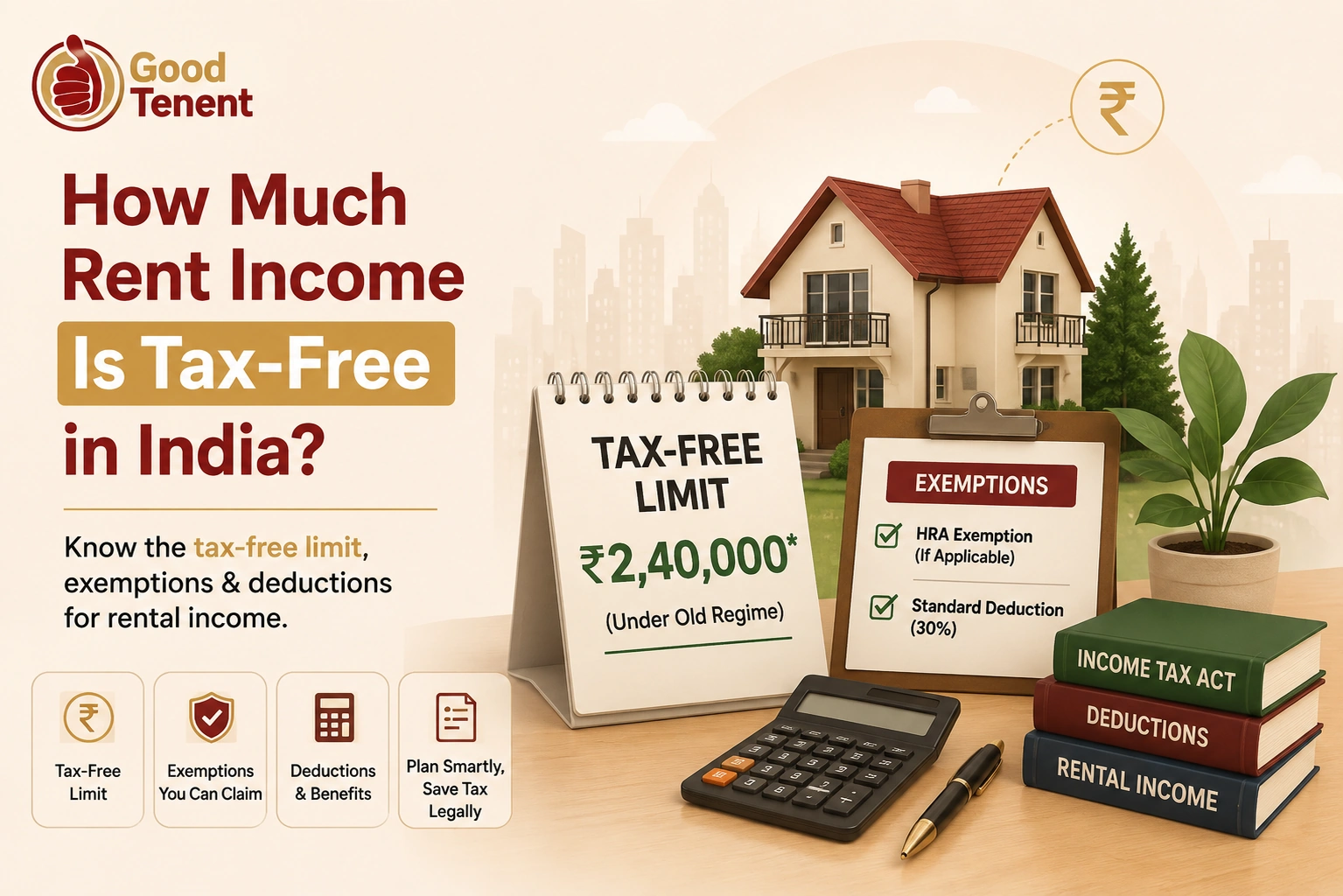
How Much Rent Income Is Tax Free in India?
How Much Rent Income Is Tax Free in India: Under the new tax regime for FY 2026-27, a landlord whose only income is rent can earn up to approximately ₹12.75 lakh a year completely tax-free — after the 30% standard deduction and the ₹60,000 rebate under Section 87A. There's no fixed rental-specific exemption; how much of your rent stays tax-free depends on your total taxable income after deductions, not the rent amount alone.
Here's exactly how that works, and what to watch for if you're a landlord in India.
What Is Rental Income as per the Income Tax Act?
The rental income is a part of "Income from the House Property" category under the Income Tax Act, covering commercial and residential properties. If you rent out your home the rent received is taxable, unless you use it for business purposes. The relevant laws cover Sections 22 to 27 of the Income Tax Act, with precise rules for calculation as well as permitted deductions.
How Much Rent Income Is Tax Free in India: Overview
| Rule/Exemption | Details and Limits |
| Basic Exemption Limit | Rs 2.5 lakh (old regime), Rs3 lakh (senior citizens), Rs4 lakh (new regime) |
| Standard Deduction | 30 percent from Net Annual Value |
| Home Loan Interest Deduction | Up to Rs 2 lakh (self-occupied) Unlimited (let-out/new policy) |
| Municipal Taxes | Deductible from gross rent |
| TDS on Rent | Mandatory if rent paid > Rs50,000/month |
Read More: Security Deposit in Rent Agreement Laws and Refund Rules
How Rent Income Is Taxed
Rent is taxed under "Income from House Property" under the Income Tax Act. The taxable amount isn't your full rent — it's calculated in three steps:
Gross Annual Value (GAV) — the actual rent you receive (or the expected fair rent, whichever is higher for a let-out property)
Less: Municipal taxes paid during the year
Less: 30% standard deduction under Section 24(a) — a flat deduction for repairs and maintenance, given automatically with no bills or proof required
Less: Home loan interest under Section 24(b), if applicable — fully deductible for a let-out property, in both tax regimes
What's left after these deductions is added to your other income and taxed at your applicable slab rate.
Worked Example
Say you earn ₹25,000/month in rent (₹3,00,000/year), with no home loan:
Step Amount
Gross Annual Value ₹3,00,000
Less: 30% standard deduction −₹90,000
Taxable rental income ₹2,10,000
If this is your only income, it falls well within the ₹12 lakh tax-free threshold under the new regime — you'd pay zero tax on it.
Read More: How to Cancel a Registered Rent Agreement in India
How Much Is Actually Tax-Free - By Regime
New Tax Regime (default for FY 2026-27):
Basic exemption: ₹4 lakh
Refund in Section 87A up to Rs 60,000, allowing income tax deduction and exceeding Rs 12 lakh tax-free
Add a standard deduction of Rs 75,000 (for salaried people who have rental income that is secondary to their source of income), and the threshold for tax-free income increases to Rs 12.75 lakh
The rebate won't be applicable to income tax at higher rates (capital gains such as lottery, crypto and so on)
Old Tax Regime:
The Section 87A rebate is up to Rs 12,500 on tax-deductible income of up to Rs 5 lakh
Lower threshold; however, you can claim more deductions, including home loan interest, Section 80C investments, and more. These deductions will be more beneficial when you have a substantial home loan on the rental property
Which is better for you? If you have no home loan and few other deductions, the new regime's higher effective threshold usually wins. If you're carrying significant home loan interest or other Chapter VI-A deductions, run the numbers under both regimes before choosing.
Read More: Understanding the Tax Implications of Rental Income in India
Is Rent Income Ever Completely Tax-Free?
In general, rental income isn't completely tax free in India. Only certain portions are exempted after deductions. Tax-free thresholds are based on the total annual income, deductions available and the type of property, whether it is self-occupied or let out. For the majority of taxpayers, only those who earn less than the threshold of basic exemption is completely tax-free. Additional relief comes from deductions that are legal.
TDS on Rent — What Tenants Must Deduct
This is a source of confusion for many landlords, which is why it's crucial to be exact:
Section 194-IB (individual or HUF tenant No tax audit is applicable) TDS 2% If the rent per month is greater than Rs50,000
Section 194-I (business/company tenant) 10% TDS when annual rent is more than Rs 2.4 lakh
NRI landlords: tenants must deduct TDS at a much higher rate — roughly 31.2% — from the very first rupee of rent, regardless of the amount
TDS deducted by your tenant isn't a separate tax — you can claim it back as a credit when filing your ITR, or it simply reduces the final amount payable.
Special Cases
Senior citizen landlords (60+): No separate rental exemption, but a higher basic exemption limit applies, and Budget 2026 doubled the senior citizen deduction limit from ₹50,000 to ₹1 lakh — increasing effective tax-free income indirectly.
Rent income that is fully exempt from taxation: Rent earned from agricultural cultivable land and income from a property belonging to a registered religious or charitable trust (for permitted purposes) are exempt from tax, regardless of the amount.
Self-occupied properties: No tax-deductible rental income exists if the renter resides in the house themselves. This section applies only to properties that are let out.
Subletting: Income from subletting is taxed under "Income from Other Sources" or "Business/Profession," not "Income from House Property," so the 30% standard deduction doesn't apply.
For More detailed info read this: TDS on Rent Above ₹50,000: Section 194-IB Rules & Form 26QC
When Rent Income Becomes Fully Tax-Free
Self-occupied Property: If no rent is paid, the property can be considered "self-occupied" and therefore exempt from tax, even for two properties according to the most recent 2025 regulations.
Low Income: When your income (including rent) does not exceed the exempt limit--Rs2.5 lakh (old regime) (old regime), 3 lakh (senior citizens) (or more than Rs 4 lakh (new regime)--it is tax-free.
HRA (House Rent Allowance): For salaried employees, HRA exemptions may apply for those who rent a house and receive HRA within their pay and a thorough documentation is required for claims of exemption.
Read More: Understanding the Model Tenancy Act
Tax Filing for Rental Income
Which ITR form should you use? ITR-1 is used for single-house property income, if the yearly amount is less than 50 lakh (not an enterprise) and ITR-2 is for more than one property or for higher incomes.
Reporting: Disclose rental earnings under "Income from House Property" in your tax return. Incorporate all deductions as well as municipal taxes that you paid.
Tips to Save Tax on Rent Income (Legally)
- All eligible deductions are claimed (standard deduction tax, interest, and standard deduction).
- You should consider the possibility of joint ownership with relatives to take advantage of their lower tax slabs.
- It is best to split rental income among your family members in order to maximize your exemptions.
- Make use of the new system's benefits, such as unlimited interest on home loan for let out properties.
Common Mistakes to Avoid
- In the event of not reporting rental income, it could lead to penalties or even a criminal prosecution.
- Not deducting TDS if rent paid is over Rs50,000/month--Section 194-IB applies strictly from FY 2026-27.
- Not taking advantage of municipal tax deductions which could reduce your the tax-deductible income.
How GoodTenent Helps Landlords Stay Compliant
Beyond tax planning, staying on the right side of rental law also means having verified tenants, a properly registered agreement, and clean digital records — all of which matter if your rental income or deductions are ever questioned during an assessment. GoodTenent's digital rental agreements and tenant verification services help landlords keep accurate, defensible records alongside their tax filings.
Frequently Asked Questions
Q1. How much rent income is tax-free in India?
Under the new regime for FY 2026-27, rental income up to approximately ₹12.75 lakh can be effectively tax-free if it's your only income, after the 30% standard deduction and Section 87A rebate.
Q2. Is rental income ever completely tax-free?
Yes, if, after all deductions your income is still below the exemption amount, no tax is due.
Q3. What is the 30% standard deduction on rental income?
A flat 30% deduction on net annual value under Section 24(a), given automatically for repairs and maintenance — no proof or bills required.
Q4. Is TDS deducted on rent paid to a landlord?
Yes — 2% under Section 194-IB for individual tenants paying over ₹50,000/month, or 10% under Section 194-I for business tenants paying over ₹2.4 lakh/year.
Q5. Can I be eligible for HRA if I earn rental income?
Employees who pay rent and also receiving HRA can apply for exemption. The landlord's PAN is required for high-value rents.
Q6. Is rental income from an NRI-owned property taxed differently?
Yes — tenants must deduct roughly 31.2% TDS from the first rupee, regardless of rent amount.
Q7. Do senior citizen landlords get extra rental income tax benefits?
There is no separate exemption for rental, however, a higher exemption limit, as well as the Budget 2026 boost to seniors' deduction (Rs 50,000 up to Rs 1 lakh), both paid indirectly.
Q8. Which tax regime is better for landlords — old or new?
The new regime usually wins with no home loan or few deductions; the old regime can work out better with significant home loan interest or Section 80C claims.
This article is intended for general informational purposes and is not tax advice. Contact a chartered accountant for advice specific to your particular circumstance.
Ready to streamline property management? Try GoodTenent for secure online rent agreements and hassle-free tenant verification—ensure legal compliance and peace of mind with every rental.