
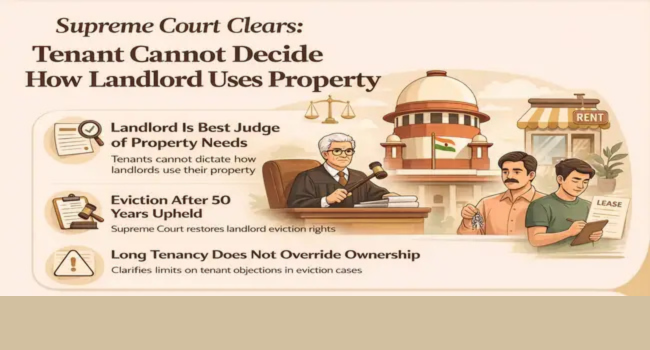
Supreme Court Clears: Tenant Cannot Decide How Landlord Uses Property
The Supreme Court of India has handed down a major ruling that clarifies what rights landlords have in Eviction proceedings and stating that a tenant cannot dictate how or where a landlord should use their own property. The ruling reinforces a long-standing legal principle that states the landlord is the best judge of their genuine requirement.
The ruling follows an ongoing dispute that has lasted more than fifty years and provides the landlord and tenant alike about the laws regarding evictions and landlord bona fide necessity as well as the limits of tenant protests.
Case Background: A 50-Year-Old Tenancy Dispute
The case began in Kamathipura, Mumbai involving a ground-floor store that was non-residential which was under lease for a number of years. The landlord demanded eviction, citing a legitimate personal need and claiming that the premises were required to conduct business by one of his family members.
The tenant fought against the eviction argument that the landlord had additional vacant rooms on upper floors that could be utilized instead. Based on this argument the case was referred to numerous judicial levels throughout the years.
Must Know: New Rent Agreement Rules for Tenants and Landlords
Timeline of Judicial Decisions
- Trial Court & First Appellate Court: It ruled in favor of the landlord
- Bombay High Court: Set aside the eviction order
- Supreme Court: Reversed the High Court decision and restored the eviction decision
Key Legal Question Before the Supreme Court
The most important problem in the case was:
Can a tenant force the landlord to rent an alternative property to the property the landlord considers suitable?
The Supreme Court answered this in a clear and decisive way - No.
Must Know: Understanding the Model Tenancy Act
Supreme Court Observations: What the Court Said
The Supreme Court made several crucial observations that are now used as guidelines in landlord-tenant dispute:
1. Landlord Is the Best Judge of Their Need
The court emphasized it was not the responsibility of the tenant to inquire into the validity of the landlord's request. If the landlord can establish the need to be genuine the court should not force other solutions that tenants suggest.
A tenant who is seeking alternative accommodation cannot dictate terms or override the landlord's stated requirements.
2. Tenant Cannot Decide Property Usage
The court ruled against the idea that the landlord should make use of upper-floor residential space instead of a shop on the ground floor.
- The upper floor was residential in nature
- The ground floor was commercially suited
- The requirements for business are different and courts should not second-guess them
3. High Court Exceeded Revisional Jurisdiction
The Supreme Court found that the Bombay High Court had outstripped its revoking power by reexamining facts that had been considered by lower courts.
Revisional jurisdiction is intended to rectify jurisdictional mistakes and not to evaluate the evidence or replace findings.
Must Know: Stamp Duty on Rent Agreement in India Rules
Final Ruling: Eviction Order Upheld
The Supreme Court ultimately restored the expulsion order in favor of the landlord, with specific conditions designed to be fair.
Conditions Imposed by the Court
- Tenant must pay off all rent arrears in the timeframe of one month.
- Tenant has to continue to pay rent in a timely manner until they leave
- Evictions allowed solely on the genuine obligation
Read More: Can a Tenant Legally Claim Ownership of a Rented House in India
Why This Judgment Matters for Landlords
This decision is vital for landlords in India especially those who face lengthy litigation due to tenant opposition.
Key Takeaways for Landlords
- Genuine requirement carries strong legal weight
- Tenants cannot force property owners to change their use
- Tenancy for a long time will not interfere with the ownership rights
- The courts will protect landlords against the misuse of delays in procedures
The judgment reinforces the fact that the rights of ownership and legitimate requirements cannot be diminished simply by the fact that a tenant has lived in the property for a long period of time.
What Tenants Should Understand from This Case
The laws protecting tenants are in place to stop arbitrary evictions. This ruling outlines their limitations.
Tenants should be aware of:
- All objections have to be legally viable and not just speculation
- Suggesting alternative premises does not invalidate landlord claims
- Tenancy for long-term leases does not give the same control as ownership
- The balance of tenant-landlord partnerships is based on legal conduct and written agreements not on the assumption.
Role of Tenant Verification in Preventing Such Disputes
Many of the long-running disputes are caused by inadequate documentation and inefficient Tenancy practices. Modern rental systems require more security and tenant verification.
This is where tenant screening services like GoodTenent become relevant.
How GoodTenent Helps Landlords
- Tenant background check before onboarding
- Digital rental agreements and checking for compliance
- Audit trails that are clear to support legal instances
- Less risk of disputes lasting for a long time and misuse
- The practice of preventive verification is usually more efficient than litigation after a dispute.
Legal Awareness Is the First Line of Protection
The Supreme Court ruling serves as an opportunity to remind us that legal certainty protects both sides; however, landlords must take proactive steps to protect their rights.
The knowledge of eviction laws, ensuring the proper documentation, and conducting tenant verification can drastically reduce the chance of disputes turning into lengthy instances.
The Supreme Court's decision sends an unambiguous warning: Tenancy cannot overrule ownership and tenants can't control how landlords utilize the property they own. For landlords it's a simple lesson to confirm, document and follow up early to avoid any disputes later.