
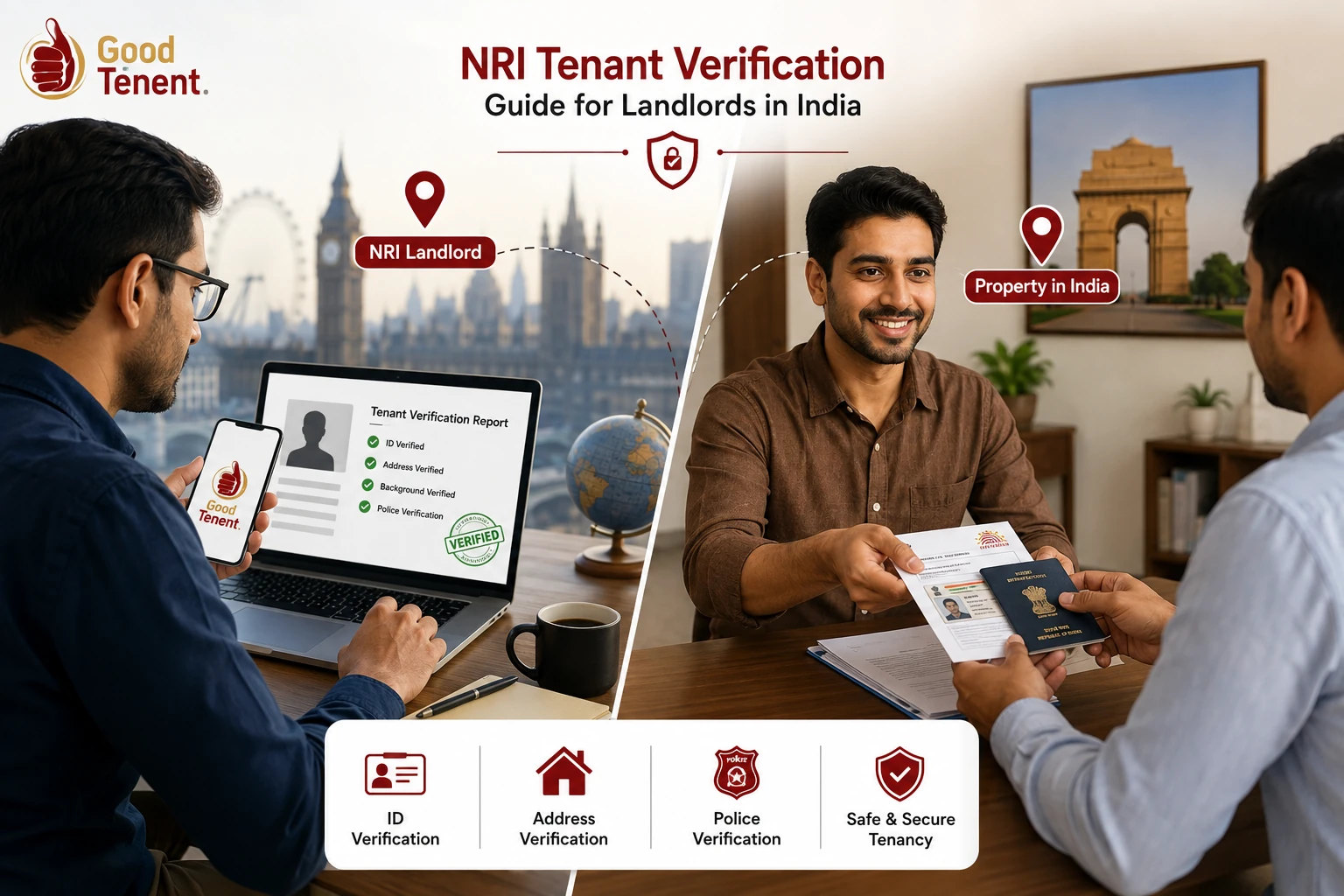
Tenant Background Verification for NRIs Renting Out Property in India
If you're an NRI who owns a flat, house, or commercial unit sitting empty in India, renting it out feels like the obvious move — until you think about who will actually live in it while you're thousands of kilometres away. You can't drop by unannounced, meet the tenant's family, or sense that something feels "off" during a conversation. This is exactly why NRI tenant verification matters more for you than it does for a landlord living in the same city as their property.
This guide will walk you through the steps an NRI landlord must take to confirm the security of tenants from abroad including the paperwork to gather and the police verification process as well as the legal aspect, common mistakes, and the steps to set up the system to verify tenants even when you're not physically there.
Why Tenant Verification Is a Bigger Risk for NRI Landlords
A resident landlord concerned about problems with the property can go to the location, talk to neighbours, or simply show up unannounced. As an NRI isn't given this option. And this gap is precisely what a small percentage of unfaithful tenants and caretakers can count on.
Here's what makes the risk sharper for NRI landlords specifically:
- You can't verify in person. Every check — ID proof, employer confirmation, references — has to happen remotely, usually through a caretaker, broker, or a digital platform.
- Distance delays discovery. If a tenant stops paying rent, sublets illegally, or damages the property, an NRI landlord often finds out weeks or months later.
- Power of Attorney (PoA) misuse. Many NRIs hand a blanket PoA to a relative or agent to sign the rental agreement and manage the tenant — and rarely audit what that person actually does with it.
- Illegal possession is a documented pattern. Legal literature on NRI property disputes repeatedly flags the same scenario: a tenant occupies the property, stops paying rent after the lease ends, and refuses to vacate — knowing a court process will likely take years and the owner is unlikely to visit often enough to push it along.
- Recovering possession is slow. Even with a valid case, eviction in India goes through legal notice, a civil suit, and formal execution of the court's decree — a process that can stretch well beyond a year if it isn't handled promptly and correctly from day one.
None of this means renting out your property is a bad idea — Indian law clearly allows NRIs to lease out residential or commercial property they own and repatriate the income after taxes. It simply means the verification step you do before handing over the keys carries more weight than it would for a landlord next door.
What Is NRI Tenant Verification?
NRI tenant verification is the process by which an NRI landlord — either directly or through a Power of Attorney holder, broker, or digital platform — confirms a prospective tenant's identity, address history, employment, and background before signing a rental agreement and handing over possession of an Indian property.
It typically covers four layers:
- Identity verification — matching the tenant's government ID to their stated name and photograph.
- Address & background verification — confirming previous residence and checking for any red flags.
- Employment/income verification — confirming the tenant can realistically afford the rent.
- Police verification — a formal, state-administered record filed with local police, separate from the landlord's own due diligence.
You can get started with GoodTenent's Tenant Verification service, which is built to run entirely from your phone or laptop, wherever you are.
It's also worth knowing that tenant verification and police verification aren't the same thing — one is due diligence you run before deciding on a tenant, and the other is a formal record filed with local authorities afterward. We've covered how the police verification process, documents, and timelines work in detail separately. For an NRI landlord, you generally need both, and the order matters: complete your own verification first, then initiate police verification once you've decided to proceed.
Documents to Collect Before Renting to a Tenant (NRI Landlord Checklist)
|
From the Tenant |
From You (the NRI Landlord / PoA Holder) |
|---|---|
|
Aadhaar Card |
Property ownership proof (sale deed/title deed) |
|
PAN Card |
Landlord's identity proof (passport/OCI card) |
|
Passport-size photograph |
Registered Power of Attorney (if signing via PoA) |
|
Previous rental agreement or landlord reference |
PAN card (mandatory in the rent agreement) |
|
Employer ID / offer letter / salary slips |
NRI status proof (passport with visa/residency page) |
|
Permanent address proof |
Address proof (Indian or overseas) |
|
Mobile number & email address |
Bank account details (NRO account for rent credit) |
A full breakdown of document requirements by state is covered in our guide on documents required for tenant verification in India.
Step-by-Step: How an NRI Can Verify a Tenant Remotely
Step 1: Decide Who Manages Verification On the Ground
Most NRIs use one of three routes — a trusted relative/friend with limited PoA, a local broker or property management service, or a digital tenant-verification platform. Platform-based solutions provide you with an auditable, documented trail rather than relying on the word of someone else -- a valuable evidence source if there is a dispute later.
Step 2: Collect and Cross-Check Tenant Documents Digitally
The prospective tenant should be able to share Aadhaar, PAN, a recent photo and proof of employment using a secure channel instead of WhatsApp screenshots that are simple to change. Verify the name, photograph along with the email address, across every document to ensure the sameness.
Step 3: Verify Employment and Income Independently
Don't rely on a payslip alone — a quick call to the HR department or a check of the company's official listing helps confirm the tenant actually works where they claim to, and that the rent is a reasonable proportion of their income.
Step 4: Check Rental History and References
Ask for the previous landlord's contact and actually call them. A tenant who has a steady positive rental history over two or more residences is much less risky than a tenant who is unable to provide only one reference.
Step 5: Draft a Registered Rental Agreement With Complete Clauses
The lease should identify the PoA the holder in writing (if you're not signing it personally) and specify the deposit, rent and notice period as well as maintenance obligations clearly. It must be signed whenever the lease period is longer than 11 months.
Step 6: Initiate Tenant Police Verification
Once you've decided to proceed, submit the tenant's details to the local police department — online where the state portal supports it, or offline through the nearest police station.
Step 7: Keep a Digital Record of Everything
Keep documents related to the agreement signed by both parties, any submitted documents, the police verification acknowledgement, and any communications with the tenant. Store these documents in a single location that you can access from anywhere. These documents are crucial if a dispute about rent or damage arises in the future.
If you want the full walkthrough of the digital process itself, see our guide on how to verify tenants online in India.
The Legal Side NRI Landlords Shouldn't Skip
Tenant verification doesn't happen in isolation — a few compliance basics protect you alongside it:
- NRO account for rent credit: Rental income should generally be credited to a Non-Resident Ordinary (NRO) account, which also allows repatriation after taxes are paid.
- TDS on rent paid to NRIs: Tenants renting from an NRI landlord are required to deduct tax at source at a rate different from what applies to resident landlords. Rules and rates here are specific and change periodically, so this is a conversation to have with a chartered accountant rather than something to rely on generic online guidance for.
- PAN in the rent agreement: Both landlord and tenant PAN numbers are typically required in the agreement — don't skip this even if you're renting through a PoA holder.
This isn't tax or legal advice — rules change and your specific situation (country of residence, DTAA applicability, PoA structure) will affect what applies to you, so loop in a CA and a property lawyer before finalising a tenancy.
Red Flags to Watch for as an Absentee Landlord
- Tenant is reluctant to share original documents or offers only screenshots/photocopies that look edited
- Employer or reference numbers go unanswered or ring to a personal number instead of an office line
- Tenant pushes to skip police verification or a registered agreement "to save time"
- Tenant insists on paying rent in cash only with no digital trail
- Tenant asks for possession before the agreement is signed and registered
- A PoA holder is reluctant to share verification documents or the signed agreement directly with you
If two or more of these show up together, slow down — a short delay in onboarding is far cheaper than a possession dispute two years later. If you're unsure whether a claim of tenancy could ever turn into a bigger ownership dispute, it's worth understanding whether a tenant can legally claim ownership of a rented house in India — the short answer is no, but the long answer explains exactly why documentation matters so much.
Common Mistakes NRI Landlords Make
- Granting a blanket, indefinite Power of Attorney instead of one limited to specific tasks and a fixed duration.
- Skipping verification because "the broker vouched for them." A broker's word isn't a substitute for documented ID, employment, and reference checks.
- Invalidating the rental contract and thereby weakening your legal standing in the event that the dispute goes to court.
- Unmonitoring the property for long periods of time without check-ins and inspections or a paper trail.
- Not informing local authorities or police about the tenancy. This could make matters more complicated in the event that a dispute requires formal records.
- Assuming rent collection = tenant is fine. Tenants who pay rent for a while and then stop, or who sublet without permission, are a recurring pattern in NRI property disputes.
How GoodTenent Helps NRI Landlords Verify Tenants Remotely
Verifying a tenant while living in a different time zone is exactly the problem a digital-first process is built to solve. With GoodTenent's Tenant Background Check, NRI landlords can collect and verify tenant documents digitally without needing to be physically present, and check prospective tenants against GoodTenent's defaulter database before signing anything.
GoodTenent does not replace police verification. It serves as a digital due-diligence layer that helps you get your documents organised and verified prior to when you begin the formal police process; therefore, there's nothing that's unexpected after they've moved in.
Frequently Asked Questions
What is NRI tenant verification?
NRI tenant verification can be described as the method that an NRI landlord employs to verify the identity of prospective tenants, the address history, their background, and employment before renting properties in India generally carried out remotely by the use of a Power of Attorney holder, broker, or a digital verification system.
Can an NRI verify a tenant without visiting India?
Yes. The NRI can authenticate tenants online by gathering the digital versions of their IDs, job and reference documentation, then cross-checking them on their own, and using a digital platform for tenant verification or a local representative who is trusted to conduct police verification in their name.
Is police verification mandatory for NRI landlords in India?
It depends on the state. There's no single national rule — some states mandate tenant police verification, while others treat it as recommended best practice. Always check your specific state or city's police department guidelines before renting out.
What documents does an NRI need to rent out property in India?
An NRI typically needs property ownership proof, a valid passport/OCI card, PAN card, and — if renting through a representative — a registered Power of Attorney. The tenant's Aadhaar, PAN, photograph, and employment proof are also required.
How is rent taxed when an NRI rents out property in India?
Tenants renting from an NRI landlord must deduct TDS on the rent paid, at a rate different from resident landlords, before crediting the balance to the landlord's account. NRIs must also file an Indian income tax return if their income exceeds the exemption threshold — a CA can confirm current rates.
What happens if a tenant refuses to vacate an NRI's property?
The landlord must send a legal notice terminating the tenancy, then file an eviction suit in civil court if the tenant still doesn't vacate. Physical force or self-help eviction is not legally permitted, even after the lease term has expired.
Does GoodTenent replace police verification for NRI landlords?
No. GoodTenent is a digital tenant verification platform that helps NRI landlords collect, verify, and organise tenant information remotely. It complements — but does not replace — the official police verification process required by local authorities.
Conclusion
Renting out property in India from abroad is entirely manageable — but it works best when verification happens before you hand over the keys, not after something goes wrong. For an NRI landlord, that means documented, digital, and independently checked verification: proper ID and employment checks, a registered agreement, timely police verification, and a paper trail you can access from anywhere in the world.
Start your tenant verification with GoodTenent today and rent out your Indian property with the same confidence you'd have if you were right next door.