Tenant Rights in India: Laws, Supreme Court Judgements & Legal Protections Explained (2026)
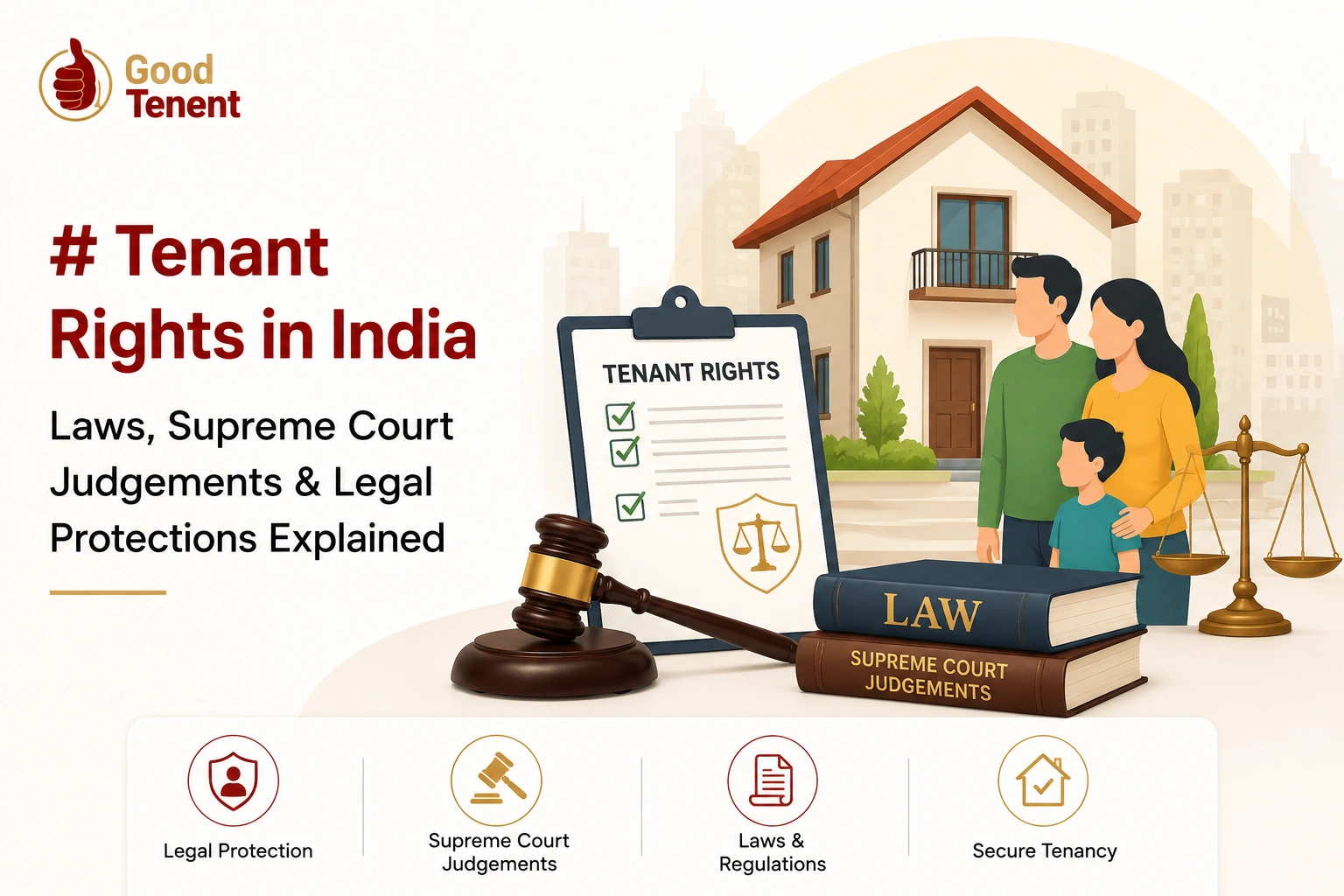
Rights of the tenant in India are derived from three sources that work together: specific state Rent Control Acts, the central Transfer of Property Act, 1882 along with the Model Tenancy Act, 2021 which the majority of states haven't yet adopted. These laws grant tenants the right of peaceful possession of the property, security against illegal expulsion, the essential services of electricity and water, as well as protection against arbitrary rent increases and notices in advance prior to any expulsion. All of the rights, regardless of the duration of a tenancy can be transformed into ownership rights of the home.
This guide will explain what the law really says and what the latest court rulings apply to long-term tenants and how tenants often misunderstand their legal rights.
Read More: Landlord Rights in India
What Are Tenant Rights in India?
Tenants' rights in India are subject to a mixture of the state Rent Control Acts, the Transfer of Property Act, 1882 (which establishes the relationship between a lessor and a tenant at an international level) as well as the Model Tenancy Act, 2021 which serves as a model framework that states can adopt in totality or in part, or in no way housing is an Indian State subject according to the Indian Constitution.
Core tenant rights include:
- Right to peaceful possession for the tenancy term
- Protection from illegal or forcible eviction
- Right to essential services (water, electricity, sanitation)
- Protection from arbitrary or excessive rent increases
- Right to advance legal notice before eviction
- Right to privacy — a landlord cannot enter without reasonable notice
These rights protect a tenant's possession of the property. They do not, under any circumstance, confer ownership. That distinction is the single most litigated point in Indian tenancy law, and it's worth understanding properly rather than by rule of thumb.
Read More: Tenant Rights vs Landlord Rights
What Indian Courts Actually Say About Long-Term Tenancy
The possession-versus-ownership distinction isn't a modern invention — it goes back to Associated Hotels of India Ltd. v. R.N. Kapoor (1959), where the Supreme Court had to decide whether a long-standing occupancy arrangement amounted to a lease or a mere licence, and rejected the argument that occupation alone creates ownership-like rights. Courts have continued to apply this logic since:
- A tenant cannot dictate how a landlord uses their own property
- Duration of tenancy, by itself, does not create ownership rights
- Courts will not protect a tenant who is misusing or abusing possession
- Eviction, when pursued through the correct legal process, is not "unfair" simply because a tenancy is long-standing
More recently, GoodTenent's own case coverage of a Delhi High Court ruling upholding a rent escalation clause in an unregistered lease (2026) shows courts continuing to enforce agreed lease terms even where registration formalities were incomplete — reinforcing that written agreement terms, not occupancy length, are what courts look to first.
Tenant Rights After 5 Years in India: What Changes?
Nothing changes automatically at the five-year mark. This is one of the most common misconceptions among long-term renters.
Reality:
- There is no statutory rule granting ownership rights after five years
- Rights continue to be governed by: the registered rent agreement, the applicable state Rent Control Act, and any renewal clauses in the lease
- A landlord can still seek eviction on valid legal grounds, regardless of tenancy length
Tenant rights after five years remain exactly what they were on day one, unless a contract has explicitly extended or altered them.
Read More: New Rent Agreement Rules in India
Tenant Rights After 10 Years in India: The Adverse Possession Question
This is where most confusion comes from, so it's worth being precise about the actual law rather than the general assumption.
The relevant statute is the Limitation Act, 1963, Article 65, which governs adverse possession — a separate legal doctrine that can, in narrow circumstances, transfer ownership of private property after 12 years of continuous possession. But adverse possession has strict conditions that ordinary tenancy does not meet:
- Possession must be open, continuous, and exclusive
- Possession must be hostile to the owner's title — meaning without the owner's permission and without acknowledging their ownership
- A tenant who pays rent, and occupies with the landlord's consent, is by definition in permissive possession — the opposite of hostile possession
Because rent-paying tenancy is inherently permissive, courts have consistently held that tenants cannot use adverse possession to claim ownership, no matter how many years they've occupied the property. Ten years of tenancy remains protected under the Rent Control Act and lease terms — not converted into an ownership claim.
Courts may still offer procedural protection against sudden or improper eviction after a long tenancy, but that protection is about process, not title. Valid grounds for eviction — non-payment of rent, unauthorised subletting, or bona fide landlord need — still apply regardless of duration.
Read More: Tenant Rights vs Landlord Rights
Tenant Rights After 20 Years in India: Myth vs Reality
Even at 20-plus years, the same adverse possession test above applies — and rent-paying tenancy still fails it on the "hostile possession" requirement.
The myth: Long enough occupancy eventually becomes ownership. The reality:
- Even decades of tenancy do not, by themselves, satisfy Article 65 of the Limitation Act, because paid, consent-based occupation isn't hostile possession
- Older Rent Control Acts (Mumbai, Delhi, Kolkata era laws) gave long-term tenants strong procedural protection, which is sometimes mistaken for ownership rights — it isn't the same thing
- The Model Tenancy Act, 2021 and recent court rulings have moved toward balancing landlord and tenant interests rather than freezing long-term tenants into quasi-ownership status
- Tenant rights after 20 years remain governed by the lease and Rent Control Act — real, but not absolute, and never a path to title
Old Tenant Rights in India: Are They Still Valid?
Older Rent Control Acts — particularly in Mumbai, Delhi, and Kolkata — historically gave tenants strong, sometimes near-permanent, protection against eviction and rent increases.
What's changed:
- The Model Tenancy Act, 2021 pushes toward a more balanced framework between landlord and tenant interests
- Courts increasingly discourage tenants relying on outdated Rent Control provisions to resist otherwise valid eviction
- Older protections still apply where the relevant state hasn't repealed or updated its Rent Control Act, but they're no longer treated as absolute
Rights of a Tenant Under Indian Land Law
Under India's property law framework, a tenant holds:
- Legal possession (not ownership) for the tenancy term
- The right to enforce the terms of a written agreement
- The right to a legal eviction process — not summary removal
- The right to security deposit refund, subject to deductions for damage
Ownership of the land or property always remains with the landlord unless there is a formal, documented transfer — sale, gift, or inheritance.
Rights of Tenants in Apartments
Apartment tenants have protections beyond the basic tenancy relationship:
- Access to common areas on the same terms as owner-residents
- Protection from discrimination by the housing society (RWA)
- Protection from forceful eviction attempts by an RWA, which has no legal authority to evict
- Protection from utility disconnection as a pressure tactic — this is illegal
These protections draw on consumer law, municipal housing rules, and state tenancy statutes together, not any single act.
Commercial Tenant Rights in India
Commercial tenancy operates under a different — generally weaker — protection regime than residential tenancy.
Key differences:
- Most state Rent Control Acts offer fewer protections to commercial tenants
- The lease agreement itself governs most terms, with less statutory override
- Eviction is comparatively easier to pursue once a lease term expires
- Courts tend to give more weight to the written contract than to tenant-protective statute
Commercial tenants should pay particular attention to lock-in period clauses, rent escalation terms, and renewal conditions before signing — disputes here usually trace back to a term the tenant didn't fully register at signing.
Sub-Tenant Rights in India
Sub-tenancy is only legally valid if the original lease explicitly permits it.
Where sub-tenancy is unauthorised:
- The sub-tenant has no direct legal standing against the original landlord
- The sub-tenant can be evicted if the main tenant defaults or breaches the lease
- Unauthorised subletting is itself valid grounds for the landlord to evict the original tenant
Read More: Dealing with Fraudulent Tenants and Fake Documents
Tenant Rules and Regulations in India
Rules vary by state, but tenants are generally expected to:
- Sign and, where applicable, register a written rent agreement
- Complete police verification where the state requires it
- Pay rent on time and as agreed
- Use the property only as specified in the agreement
- Maintain peaceful coexistence with neighbours and the housing society
Violating these obligations can weaken a tenant's legal standing in a dispute — even a strong Rent Control Act won't protect a tenant who's clearly in breach.
Read More: Tenant-Landlord Rights in India
Common Mistakes Tenants Make
- Occupying under a verbal or unregistered agreement
- Assuming long tenure equals ownership
- Ignoring formal legal notices instead of responding to them
- Subletting without the landlord's written consent
- Not keeping documented proof of rent payments (receipts, bank transfers)
Each of these mistakes weakens a tenant's position significantly if a dispute ends up in front of a Rent Court or civil court.
Frequently Asked Questions
Q1. What are tenant rights in India?
Tenants are entitled to peaceful possession of their property, essential services, protection from arbitrary rent hikes, advance notice prior to the eviction date, and privacy, all of which are administered by states' Rent Control Acts, the Transfer of Property Act, 1882 along with the Model Tenancy Act, 2021 when it is adopted.
Q2. Does long-term tenancy give a tenant ownership rights?
No. Even a tenancy for 20 or more years doesn't confer ownership. The only way to own solely through occupancy is negative possession in accordance with the Limitation Act, 1963, which requires 12 years of non-permissive and hostile possession, a requirement that rent-paying tenants do not meet.
Q3. Can a landlord evict a tenant at any time?
No. Evictions have to be based on legal requirements (such as non-payment of rent or unauthorised subletting, or a genuine necessity) as well as the legal procedure, such as the right to notice.
Q4. Are tenants in apartments protected from housing society harassment?
Yes. Tenants of apartments are protected from discrimination, evictions that are forced through an RWA and utility disconnects as a tactic of pressure.
Q5. Do commercial tenants have the same protections as residential tenants?
No. Commercial tenants typically have less legal protections under the law and courts tend to give more weight to leases that are written than legislation protecting tenants.